

UF: Urea-Formaldehyde
PREMIUM technology for long-term, biologically regulated nitrogen release
UF technology (Urea-Formaldehyde), based on urea and formaldehyde, is an advanced form of nitrogen with slow, biologically controlled release, widely used in the professional care of sports, golf and municipal turf. It is one of the oldest, most proven and best-documented solutions in the slow-release fertiliser family.
In UF technology, nitrogen is chemically bound in long polymer chains. After application, it does not immediately dissolve in water; instead, soil microorganisms gradually break it down and make it available to plants. Unlike readily available fertilisers, UF provides a long-term, even nutrient supply without growth flushes, while reducing nitrogen losses to the environment.
How does UF technology work?
Nitrogen in UF fertilisers is bound in long, water-insoluble polymer chains formed by synthesising urea and formaldehyde. Nitrogen release is biologically regulated: its rate depends on soil microorganism activity, soil temperature and soil moisture.
Microbial breakdown: soil bacteria and fungi gradually break down the polymer chains, releasing nitrogen in a plant-available form.
Regulation by soil conditions: the breakdown rate increases with temperature and moisture, the same conditions in which turf actively grows and takes up nutrients.
Long-term action: UF technology allows nitrogen release over a period of up to one year, significantly longer than standard fertilisers and MU-type fertilisers.
This mechanism delivers nutrients at a rate matching actual requirements, rather than all at once after application.
Fractional composition: precise control of the release rate
UF fertilisers are designed to release nitrogen gradually. Their chemical structure contains three fractions with different solubilities and mineralisation rates:
| Fraction | Chemical characteristics | Agronomic function |
| CWS (Cold Water Soluble) | Fraction soluble in cold water | Provides a rapid initial response: immediate nitrogen availability in the first days after application |
| CWIN (Cold Water Insoluble) | Fraction insoluble in cold water but soluble in hot water | Released at an intermediate rate, supplying nitrogen over several weeks |
| HWIN (Hot Water Insoluble) | The fraction most resistant to breakdown | Forms a nitrogen reserve for many months, responsible for the fertiliser's extended action |
The ratio of these fractions determines a UF fertiliser's behaviour, from a rapid initial response to long-term, stable nitrogen availability throughout the growth cycle.
UF and MU: a precise technological distinction
UF technology develops and strengthens the operating principle of MU fertilisers (methylene urea). Both solutions share the fundamental idea of chemically binding nitrogen in polymer chains that soil microorganisms break down. However, they differ significantly in chain length, structural complexity and duration of action:
| Parameter | MU (methylene urea) | UF (Urea-Formaldehyde) |
| Polymer chain length | Shorter, less complex | Significantly longer, highly water-insoluble |
| Rate of microbial breakdown | Faster | Significantly slower |
| Duration of action | Several weeks | Up to 12 months |
| Characteristics | Fertiliser with an intermediate delay in release | Fertiliser with long-term, stable action |
| Position within the GreenPlan range | Basic slow-release technology | PREMIUM long-term release technology |
UF can be considered the older, stronger brother of MU: a technology used wherever the longest possible controlled nutrient supply is required with a minimum number of maintenance operations.
Benefits of UF technology in GreenPlan systems
Using UF fertilisers in GreenPlan programmes provides specific operational benefits:
Stable, long-term turf growth without the flushes typical of readily available fertilisers;
Several months of action from a single application, up to 12 months depending on the fraction ratio;
Significantly reduced nitrogen losses to the environment: nitrogen bound in polymer chains is neither leached nor released as volatile nitrogen;
Lower risk of emissions and groundwater eutrophication;
Greater resilience to stress factors, including drought, high temperatures and intensive play;
More efficient root uptake of nutrients through synchronisation of release with soil biological activity;
Fewer maintenance operations, significantly simplifying logistics on large sites;
Application safety, practically eliminating the risk of local over-fertilisation.
UF in practice
GreenPlan UF fertilisers are designed for sites that require a long-term, stable nutrient supply and an optimised number of maintenance operations:
Top-division football pitches with intensive match schedules;
Golf courses, including fairways, rough and driving ranges;
Grass tennis courts;
Urban parks and recreational areas;
Intensively used residential and commercial properties;
Large sites requiring fewer fertiliser applications.
This technology is selected wherever results need to be long-lasting, predictable, environmentally safe and logistically efficient.
UF in GreenPlan fertilisers: positioning the premium technology
Within the GP Sport range, UF technology forms the core of the mineral slow-release formulations: GP Klassik 20-5-8+4, GP NK 15+0+20+3, GP Allround 16-4-16+2, GP Starter 12-22-10+2 and GP Finale 10+5+20 (+6 CaO +4 MgO +16 SO₃).
This is the solution for professionals who expect:
Long-term stability of turf nutrition throughout the growth cycle;
Precise control of the nitrogen release rate;
Complete control over turf growth and regeneration;
Environmental safety through minimised nitrogen losses to groundwater and the atmosphere;
Operational efficiency: fewer maintenance operations without loss of turf quality.
Within GreenPlan systems, UF technology is a strategic tool for managing turf quality: proven, reproducible and predictable under all operating conditions.
FROM KNOWLEDGE TO PRODUCT
Related products.
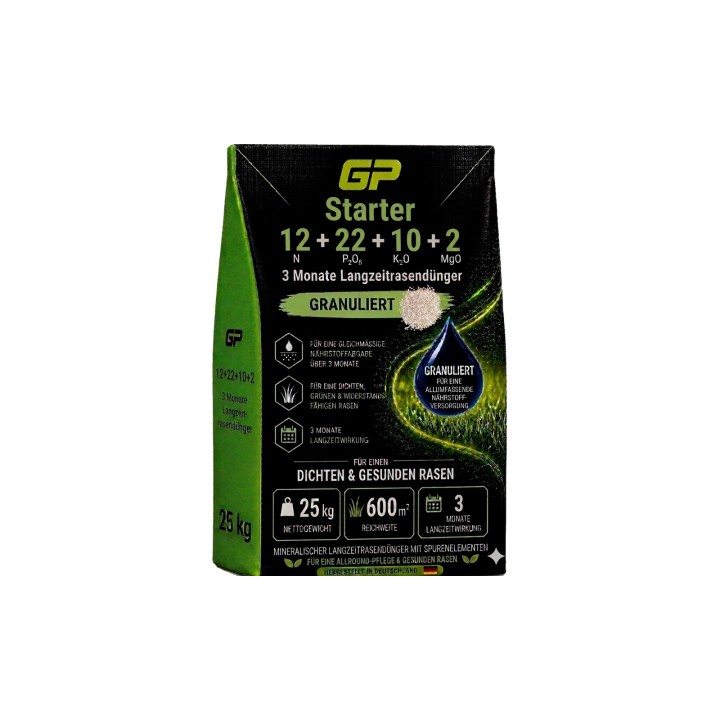
GP Starter 12-22-10
Explore product ↗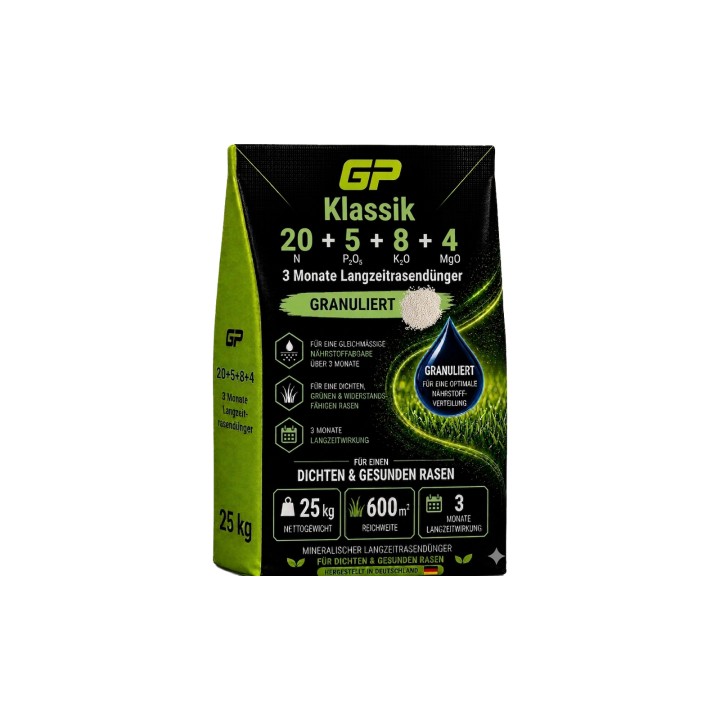
GP Klassik 20-5-8
Explore product ↗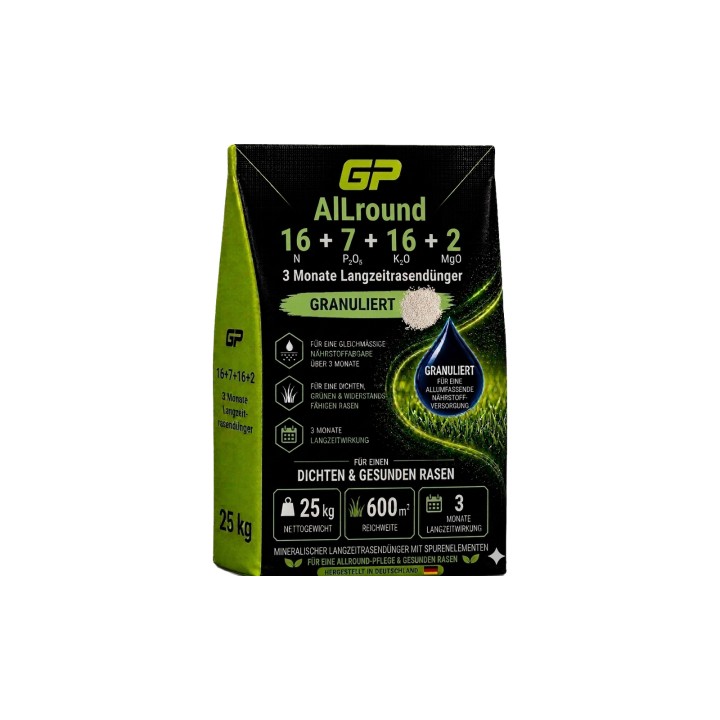
GP Allround 16-7-16
Explore product ↗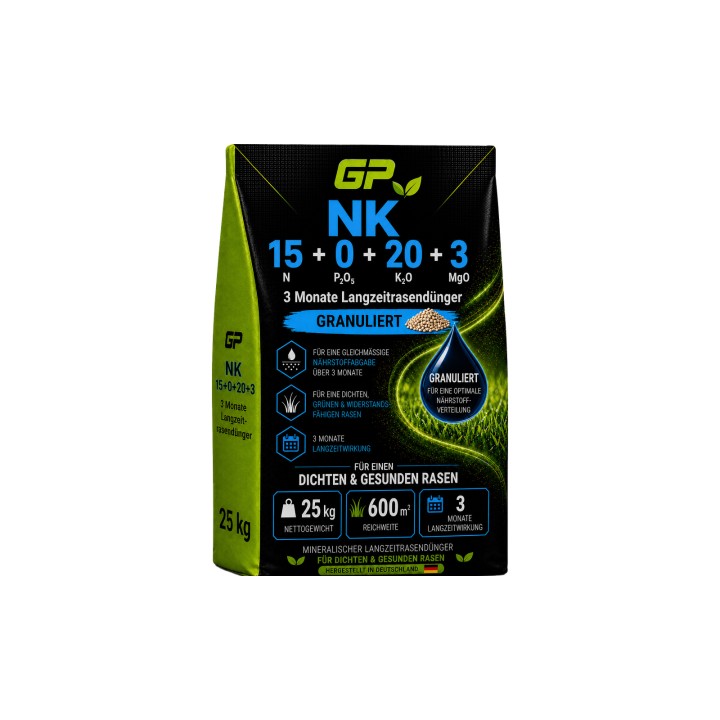
GP NK 15-0-20
Explore product ↗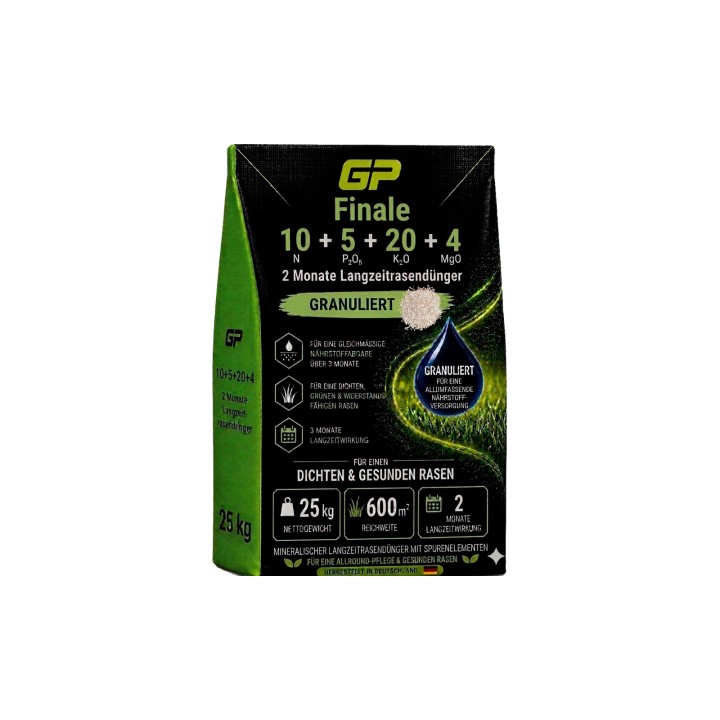
GP Finale 10-5-20
Explore product ↗Select two or three products.
Compare product data
| Product | Product data |
|---|---|
| GP Starter 12-22-10 | Total nitrogen (N): 12 % Of which ammonium nitrogen: 12 % Phosphate (P₂O₅): 22 %; of which 16 % is water-soluble Potassium oxide (K₂O): 10 %, water-soluble Sulphur (S): 7 %, water-soluble Iron (Fe): 2 %, Gesamt Technology: UF (urea formaldehyde): biologically regulated nitrogen release Characteristics: Low in chloride |
| GP Klassik 20-5-8 | Composition: NPK 20-5-8 (+4 MgO +9 S) + 1 % Fe Application rate: 30–50 g/m² Coverage per 25 kg pack: 500–825 m² Duration of action: Up to 3 months Granule size range: 1.0–3.15 mm Application timing: Spring / summer / autumn: the entire growing season Total nitrogen (N): 20 % Of which ammonium nitrogen: 7.5 % Of which urea nitrogen: 7.5 % Of which nitrogen in UF form (urea formaldehyde): 5.0 % Cold-water-soluble (CWS): 2.1 % Hot-water-soluble (CWIN/HWIN): 1.7 % Phosphate (P₂O₅): 5 %; of which 3.5 % is water-soluble Potassium oxide (K₂O): 8 %, water-soluble Magnesium oxide (MgO): 4 %; of which 2 % is water-soluble Sulphur (S): 9 %, water-soluble Iron (Fe): 1 %, Gesamt |
| GP Allround 16-7-16 | Composition: NPK 16-7-16 (+2 MgO +10 S) + trace elements (B, Cu, Fe, Mn, Zn) Application rate: 30–50 g/m² Coverage per 25 kg pack: 500–825 m² Duration of action: Up to 3 months Granule size range: 1.0–3.15 mm Application timing: Spring / summer / autumn: the entire growing season Total nitrogen (N): 16 % Of which ammonium nitrogen: 5.0 % Of which urea nitrogen: 5.0 % Of which nitrogen in UF form (urea formaldehyde): 6.0 % Cold-water-soluble (CWS): 1.8 % Hot-water-soluble (CWIN/HWIN): 4.2 % Phosphate (P₂O₅): 7 %; of which 5 % is water-soluble Potassium oxide (K₂O): 16 %, water-soluble Magnesium oxide (MgO): 2 %, Gesamt Sulphur (S): 10 %; of which 8 % is water-soluble Boron (B): 0.01 %, water-soluble Copper (Cu): 0.02 %, water-soluble Iron (Fe): 0.65 %, water-soluble Manganese (Mn): 0.01 %, water-soluble Zinc (Zn): 0.02 %, water-soluble Characteristics: Low in chloride |
| GP NK 15-0-20 | Composition: NK(Mg, SO3) 15+20 (+3+22) Total nitrogen (N): 15.0 % Ammonium nitrogen (N): 3.0 % Urea nitrogen (N): 8.0 % Urea formaldehyde nitrogen (N): 4.0 % Potassium oxide (K₂O), water-soluble: 20.0 % Total magnesium oxide (MgO): 3.0 % Water-soluble magnesium oxide (MgO): 2.0 % Water-soluble sulphur trioxide (SO₃): 22.0 % Iron (Fe): 1.0 % As water-soluble sulphate: 0.9 % Granule size: 90 % zwischen 2.0 mm und 5.0 mm Application rate: 25–30 g/m² per fertilisation |
| GP Finale 10-5-20 | Composition: NPK (Ca, Mg, S) 10+5+20 (+6+4+16) Total nitrogen (N): 10.0 % Ammonium nitrogen (N): 7.0 % Urea nitrogen (N): 0.5 % Urea formaldehyde nitrogen (N): 2.5 % Total phosphorus pentoxide (P₂O₅): 5.0 % Water-soluble phosphorus pentoxide (P₂O₅): 4.0 % Neutral ammonium citrate-soluble phosphorus pentoxide (P₂O₅): 5.0 % Potassium oxide (K₂O), water-soluble: 20.0 % Total calcium oxide (CaO): 6.0 % Total magnesium oxide (MgO): 4.0 % Total sulphur trioxide (SO₃): 16.0 % Water-soluble sulphur trioxide (SO₃): 16.0 % Granule size: 90 % zwischen 2.0 mm und 5.0 mm Application rate: 30–50 g/m² per application |
CONNECT KNOWLEDGE
Read more.

TOGETHER FOR YOUR PITCH