
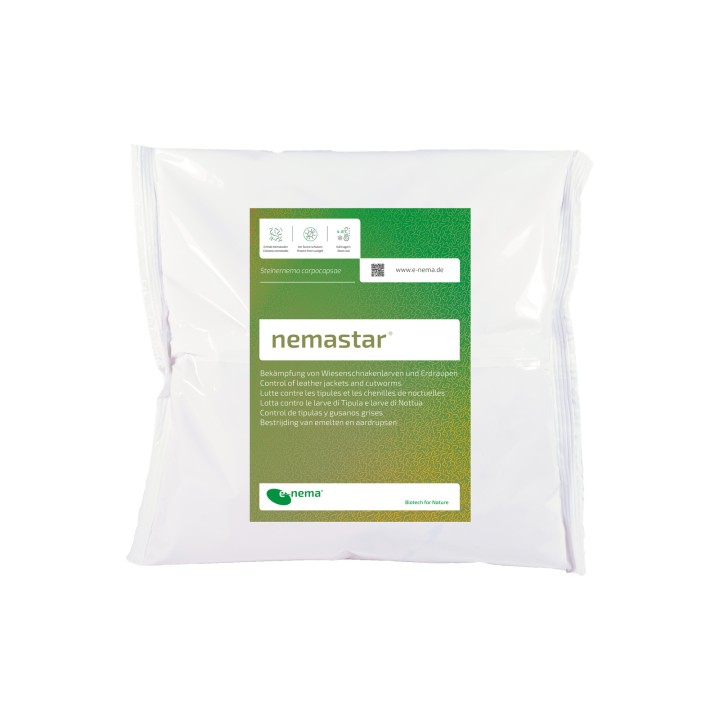
nemastar® images
FOR YOUR PITCH
nemastar® contains living beneficial Steinernema carpocapsae nematodes. Developed primarily against young crane fly larvae (Tipula spp.) in turf, it can also be used against cutworms (Agrotis spp.) and mole crickets (Gryllotalpa gryllotalpa).
Let us discuss your requirements and the right application.
Living beneficial organisms for susceptible stages of soil-dwelling pests;
A central biological solution against leatherjackets in the sward;
Particularly effective against young Tipula spp. larvae at L1/L2;
IN RHYTHM WITH YOUR TURF
Application.
At the right time.
Marsh crane fly (Tipula) – September–October Cabbage crane fly – May and September–October Cutworms – June–September Mole crickets – April–September
APPLICATIONS
Leatherjackets (Tipula)
Cabbage crane flies
Cutworms
Mole crickets
THE PRODUCT IN DETAIL
Understand what
Your turf needs.
BIOLOGICAL TURF PROTECTION AGAINST LEATHERJACKETS AND CUTWORMS
nemastar®
Beneficial Steinernema carpocapsae nematodes for biological regulation of soil-dwelling pests
| Steinernema carpocapsae • water-soluble formulation • apply to moist soil • protect from strong UV |
Short description
nemastar® contains living beneficial Steinernema carpocapsae nematodes. Developed primarily against young crane fly larvae (Tipula spp.) in turf, it can also be used against cutworms (Agrotis spp.) and mole crickets (Gryllotalpa gryllotalpa).
The best crane fly results occur against young L1/L2 larvae. Four factors determine success: correct pest identification, application around two weeks after peak adult flight, consistently moist soil and soil temperature above 14°C for several hours afterwards.
Key properties
Living beneficial organisms for susceptible stages of soil-dwelling pests;
A central biological solution against leatherjackets in the sward;
Particularly effective against young Tipula spp. larvae at L1/L2;
Key properties
Can be applied through irrigation systems, watering or soil injection;
The manufacturer reports field-trial effectiveness of up to 82% against young Tipula paludosa larvae;
No chemical residues; effectiveness depends on vitality, target stage and conditions.
Target pests and application period
| Target pest / stage | Recommended period and rate |
| Crane flies / Tipula spp. | After peak flight, usually mid-September to mid-October; 0.5 million nematodes/m² |
| Cutworms / Agrotis spp. | When susceptible larvae occur; generally 0.25–0.5 million nematodes/m² |
| Mole crickets / Gryllotalpa gryllotalpa | During young-stage activity; adapt timing to local conditions |
How do beneficial nematodes work?
Infective nematode stages search for a suitable soil host, enter it and release symbiotic bacteria. These multiply and kill the larva. Nematodes reproduce inside the dead host; new infective stages emerge and seek other susceptible larvae.
When is this product the right choice?
Choose nemastar® for leatherjackets or other susceptible soil pests where reliable moisture and suitable Steinernema carpocapsae soil temperature can be maintained. Use the appropriate nema-green® variant for scarab beetle grubs.
Preparation and application
Identify the pest and stage. For crane flies, treat around two weeks after peak flight, before larvae reach older stages.
Pre-water the soil. Moisten dry ground in good time; nematodes move only in the soil water film.
Prepare a fresh suspension. Dissolve the entire pack according to current instructions and keep uniformly suspended during application.
Apply evenly. For Tipula, use at least 100 ml spray mixture per m²; remove filters and nozzles that could retain nematodes.
Irrigate immediately afterwards, washing nematodes off leaves and through thatch into soil; maintain moisture as instructed.
Conditions for successful application
Moist soil and sward before, during and after treatment;
Soil above 14°C for several hours after application;
Moist, overcast weather or evening application;
No strong sunlight or drying wind;
Stir regularly and use the suspension without unnecessary delay.
| Nematodes are living organisms. Success depends on rate, correct pest species, susceptible stage, soil temperature, moisture and UV protection. |
Technical data
| Active organism | Steinernema carpocapsae |
| Formulation | Nematodes in a water-soluble carrier |
| Rate: Tipula spp. | 0.5 million nematodes/m²; at least 100 ml application mixture/m² |
| Rate: cutworms | 0.25–0.5 million Nematoden/m² |
| Soil temperature | Above 14°C for several hours after application |
| Main period: Tipula | Mid-September–mid-October, around 2 weeks after peak flight |
| Shelf life | Unopened and correctly refrigerated for up to 6 weeks; the label is authoritative |
Storage and handling
Contains living organisms. Refrigerate immediately on receipt; protect from overheating, frost and sunlight, and use before the printed date. Do not divide dry contents by eye because nematodes may not be evenly distributed in the carrier.
Frequently asked questions
Does nemastar® affect adult crane flies?
Adults are not the primary target. Susceptible soil larvae, especially L1/L2, are treated.
Why is timing important?
Older crane fly larvae are less susceptible. The optimum point is around two weeks after peak flight.
Can treatment be applied in full sun?
Not recommended. Nematodes are sensitive to UV and drying; moist overcast weather or evening is better.
Must the area be irrigated afterwards?
Yes. Immediate irrigation transports nematodes from leaves and thatch into moist soil.
| Important: check the rate, timing and aftercare against the current label. Do not use after the expiry date. |
Application calendar according to the current brochure
| Effective against | Application period |
| Leatherjackets (Tipula) | September–October |
| Cabbage crane flies | May and September–October |
| Cutworms | June–September |
| Mole crickets | April–September |
PRECISELY DECLARED
Technical
Data.
- Active organism
- Steinernema carpocapsae
- Formulation
- Nematodes in a water-soluble carrier
- Rate: Tipula spp.
- 0.5 million nematodes/m²; at least 100 ml application mixture/m²
- Rate: cutworms
- 0.25–0.5 million Nematoden/m²
- Soil temperature
- Above 14°C for several hours after application
- Main period: Tipula
- Mid-September–mid-October, around 2 weeks after peak flight
- Shelf life
- Unopened and correctly refrigerated for up to 6 weeks; the label is authoritative
Documents & downloads
The PDF documents are available in German.
Turf protection with nematodesFROM SELECTION TO APPLICATION