
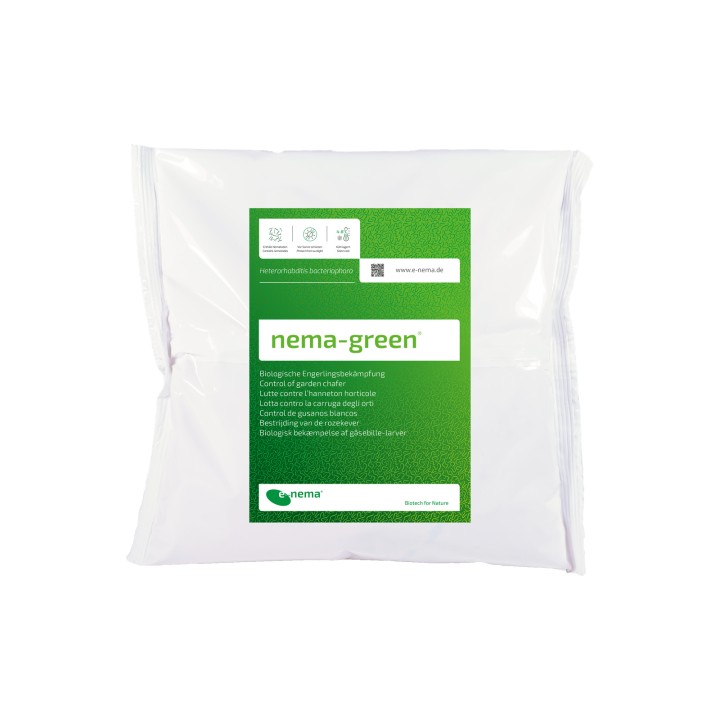
nema-green® images
FOR YOUR PITCH
nema-green® contains beneficial Heterorhabditis bacteriophora nematodes for biological control of susceptible soil grubs. Targets include garden chafer, summer chafer, Japanese beetle and Hoplia philanthus larvae.
Let us discuss your requirements and the right application.
Specifically selected beneficial organism: Heterorhabditis bacteriophora;
Biological regulation of grubs feeding on turf roots;
Area rate of 0.5 million nematodes/m²;
IN RHYTHM WITH YOUR TURF
Application.
At the right time.
Garden chafer – July–September Hoplia philanthus (Purzelkäfer) – April–September Summer chafer – August Dung beetle – April–June Japanese beetle – August–September Julikäfer (German pest name) – April–May and August–September
APPLICATIONS
Garden chafer
Purzelkäfer (German pest name)
Summer chafer
Dung beetles
Japanese beetle
Julikäfer (German pest name)
THE PRODUCT IN DETAIL
Understand what
Your turf needs.
BIOLOGICAL GRUB CONTROL IN TURF AND GREEN SPACES
nema-green®
Beneficial Heterorhabditis bacteriophora nematodes against susceptible beetle larvae
| Heterorhabditis bacteriophora • 0.5 million nematodes/m² • apply April to September depending on grub species |
Short description
nema-green® contains beneficial Heterorhabditis bacteriophora nematodes for biological control of susceptible soil grubs. Targets include garden chafer, summer chafer, Japanese beetle and Hoplia philanthus larvae.
Different grub species are susceptible at different life-cycle stages, so no universal application date exists. Identify the beetle first, then match treatment to young larvae and suitable soil moisture and temperature.
Key properties
Specifically selected beneficial organism: Heterorhabditis bacteriophora;
Biological regulation of grubs feeding on turf roots;
Area rate of 0.5 million nematodes/m²;
Key properties
Apply with a watering can or suitable nematode sprayer;
Best conditions are moist soil without direct sunlight;
Choose timing by beetle species and developmental stage, not visible turf damage alone.
Target pests and application period
| Target pest / stage | Recommended period and rate |
| Garden chafer / Phyllopertha horticola | From mid-July, 6–8 weeks after beetle flight, until late September |
| Summer chafer / Amphimallon solstitiale | From early August, around 4–6 weeks after beetle flight |
| Hoplia philanthus (Purzelkäfer) | April–early May, once daytime soil temperature reaches 12°C |
| Japanese beetle / Popillia japonica | August–September against soil larvae |
How do beneficial nematodes work?
Infective nematode stages search for a suitable soil host, enter it and release symbiotic bacteria. These multiply and kill the larva. Nematodes reproduce inside the dead host; new infective stages emerge and seek other susceptible larvae.
When is this product the right choice?
Choose standard nema-green® when grubs listed in the current instructions have been identified. It does not automatically replace nema-green® Maikäfer: cockchafer grubs require a separate nematode combination and two-treatment programme.
Preparation and application
Identify the grub species. Larval size and damage alone do not reliably determine timing; use an identification service if uncertain.
Choose the treatment window using the identified beetle's life cycle and current instructions.
Moisten soil thoroughly. Pre-water dry areas so nematodes can reach the root zone.
Prepare and distribute the suspension evenly. Mix the whole pack with water and apply at 0.5 million nematodes/m².
Maintain moisture afterwards. Wash nematodes from plants into soil and prevent drying for the label-specified period.
Conditions for successful application
Reliably identified grub species and susceptible larval stage;
Moist soil allowing active nematode movement;
Overcast, moist weather or evening application;
Protect suspension from sun, warming and prolonged standing;
Soil temperature as specified for the pest; for Hoplia philanthus, at least 12°C during daytime.
| Nematodes are living organisms. Success depends on rate, correct pest species, susceptible stage, soil temperature, moisture and UV protection. |
Technical data
| Active organism | Heterorhabditis bacteriophora |
| Target | Susceptible soil larvae of selected scarab beetles |
| Application rate | 0.5 million Nematoden/m² |
| Pack variants | 5 million/10 m², 10 million/20 m², 25 million/50 m², 50 million/100 m² |
| Application period | April–late September, depending on grub species |
| Application | Watering can or nematode-compatible sprayer / irrigation equipment |
| Storage | 2–8°C; unopened for up to 6 weeks; the label is authoritative |
Storage and handling
Store at 2–8°C without frost until use. Use before the printed date. Stir the prepared suspension regularly and apply without delay; do not leave living nematodes in a hot container or sunlight.
Frequently asked questions
Does nema-green® work against all grubs?
No. It targets specific species and stages. Identify the pest and check current instructions.
Do yellow patches prove grub infestation?
No. Similar symptoms have other causes. Confirm diagnosis by inspecting the root zone and identifying larvae found.
Is it suitable for cockchafer grubs?
Use nema-green® Maikäfer for those. It contains two nematode genera and uses a two-treatment programme.
Can the dry pack be divided?
Not recommended. Nematodes may be unevenly distributed in the carrier; prepare the whole pack and treat according to instructions.
| Important: check the rate, timing and aftercare against the current label. Do not use after the expiry date. |
Application calendar according to the current brochure
| Effective against | Application period |
| Garden chafer | July–September |
| Purzelkäfer (German pest name) | April–September |
| Summer chafer | August |
| Dung beetles | April–June |
| Japanese beetle | August–September |
| Julikäfer (German pest name) | April–May and August–September |
PRECISELY DECLARED
Technical
Data.
- Active organism
- Heterorhabditis bacteriophora
- Target
- Susceptible soil larvae of selected scarab beetles
- Application rate
- 0.5 million Nematoden/m²
- Pack variants
- 5 million/10 m², 10 million/20 m², 25 million/50 m², 50 million/100 m²
- Application period
- April–late September, depending on grub species
- Application
- Watering can or nematode-compatible sprayer / irrigation equipment
- Storage
- 2–8°C; unopened for up to 6 weeks; the label is authoritative
Documents & downloads
The PDF documents are available in German.
Turf protection with nematodesFROM SELECTION TO APPLICATION